Why Am I Successful But Unhappy? The Truth I Had to Almost Die to Learn

The Question You Won't Say Out Loud — But Can't Stop Thinking
You have the career. You have the income. You have the title, the house, the respect of people who matter in your industry. From the outside, your life looks like the answer to a question most people are still asking. And yet here you are, late at night or early in the morning, with a quiet voice inside you asking something that feels almost shameful to admit: why am I so unhappy? Why does none of this feel like enough? Why, after everything I've worked for, does this feel so hollow?
I know that question. I lived inside it for years without knowing how to name it. I built a career on Wall Street that most people would have traded anything for. I put in the hours, earned the money, hit the milestones, and kept moving — because moving was the only thing that made the discomfort manageable. If I was achieving, I didn't have to sit with the feeling that something was profoundly wrong. The achievement was the anesthetic. The problem was that it wore off faster and faster, and the dose I needed to feel something kept getting larger.
If you've found this article, you're probably not looking for a motivational speech. You're looking for someone to tell you the truth. So here it is: the success you built was real. The effort was real. The sacrifice was real. And the emptiness you feel right now is also real — not a malfunction, not ingratitude, not a sign that something is wrong with you. It is, in fact, the most honest signal your life has ever sent you. The question is whether you are willing to listen to it before it costs you everything.
How Success Becomes a Trap You Built With Your Own Hands
Nobody tells you this when you're climbing. The story we're given about success is linear: work hard, achieve, arrive, feel fulfilled. It's a story that holds up just long enough to keep you moving. You hit the first goal and there's a genuine rush — a few days or weeks where it actually feels like you thought it would. Then the feeling fades. The goalposts move. You tell yourself the next level will be the one that finally sticks. And so you climb again.
This cycle isn't a character flaw. It has a name. Psychologists call it the hedonic treadmill — the human tendency to return to a stable emotional baseline regardless of what we achieve or acquire. Researchers have documented it in lottery winners, in newly promoted executives, in people who get the thing they were certain would change everything. The change is real, but it's temporary. The brain adapts. What felt extraordinary becomes ordinary. And ordinary, after you've burned yourself down to get there, can feel like a kind of betrayal.
What makes this particularly cruel for high achievers is that the same drive that got them there — the restlessness, the hunger, the refusal to be satisfied — is also what prevents them from ever landing. The qualities that built the career are the same qualities that make the career feel like a ceiling. You are too smart to be fooled by the next milestone for long, and too conditioned by decades of striving to stop reaching for one. You are caught between your ambition and your awareness, and the gap between them is where the unhappiness lives.
I spent years in that gap without understanding what it was. I would reach a new level — a better title, a larger book of business, a bigger number at year end — and I would feel the brief warmth of it before the cold returned. I told myself I just needed to push a little harder, get a little further, prove a little more. What I didn't understand then, and what took something close to catastrophe for me to learn, is that you cannot outrun a problem that lives inside you. More of the same thing that created the emptiness will not fill it.
What Wall Street Taught Me — And What It Couldn't
I spent the better part of my adult life working in finance. I understood markets, risk, return. I understood how to build a career around numbers that mattered. What Wall Street is extraordinarily good at is teaching you to measure things — performance, return on investment, efficiency, output. It rewards the measurable. It builds entire cultures around it. And there is real value in that discipline. I'm not dismissing it.
But there is something Wall Street cannot measure, and because it cannot measure it, the culture tends to pretend it doesn't exist. It cannot measure the cost of what you gave up. It cannot quantify the relationships that eroded while you were building the portfolio. It has no metric for the years your kids grew up while you were on calls. It produces no spreadsheet for the version of yourself you slowly traded away — the curious, present, alive version — in exchange for a net worth that looks impressive on paper and feels strangely light in the chest.
I saw this pattern in my colleagues before I could see it in myself. The most successful people I knew were also, in many cases, the most quietly desperate. They had mastered the language of confidence and competence. They were extraordinary at performing certainty in a boardroom. But strip away the performance — catch them in a rare honest moment, usually after a drink or two at the end of a long conference — and a different story emerged. Marriages that were surviving rather than thriving. Kids who barely knew their fathers. A sense that the life being lived was somehow adjacent to the life that was supposed to be happening. Close enough to fool everyone else. Not close enough to fool yourself at 3 in the morning.
What I took from those years is not cynicism about success or achievement. I still believe in the value of building something, in the dignity of excellent work, in the satisfaction of solving hard problems. What I no longer believe is that those things, on their own, are enough to constitute a life. They are ingredients. They are not the meal. And if you've spent twenty years treating the ingredients as the point, you will eventually arrive at a table with nothing to actually eat — and wonder why you're still hungry.
Why Successful People Are the Last to See It Coming
There is a particular kind of blindness that comes with high achievement, and it is not stupidity — it is the opposite. Intelligent, driven people are extraordinarily good at rationalizing their choices. Every trade-off gets a justification. Every missed moment gets a narrative. I'm doing this for my family. I'll slow down after this quarter. Once we close this deal, I'll take a real vacation. The mind that is sharp enough to win at a demanding career is also sharp enough to construct airtight explanations for why the warning signs don't apply to you.
There is also a social dimension to this blindness that is rarely discussed honestly. When everyone around you is playing the same game — when your entire social and professional world is built on the shared assumption that more is better, that busyness signals worth, that the calendar full of meetings is the proof of a life well spent — it becomes almost impossible to see the game for what it is. Dissent requires a reference point outside the system. Most high achievers don't have one. Their friendships are with people just like them. Their weekends are structured around productivity. Even their vacations have agendas.
I didn't find my reference point by choice. It was handed to me by a cancer diagnosis that arrived with the subtlety of a hammer. There is nothing like a brush with mortality to strip away the rationalizations. When the doctor is telling you that your body has turned against you, you are suddenly and violently liberated from the illusion that there is always more time, always another quarter, always a later date to start living the life you actually want. The calendar clears. The priorities rearrange themselves with a brutality that no amount of self-help reading could have produced. What remains when the pretense is gone is very simple: the people you love, the moments you were actually present for, and a fierce regret about everything else.
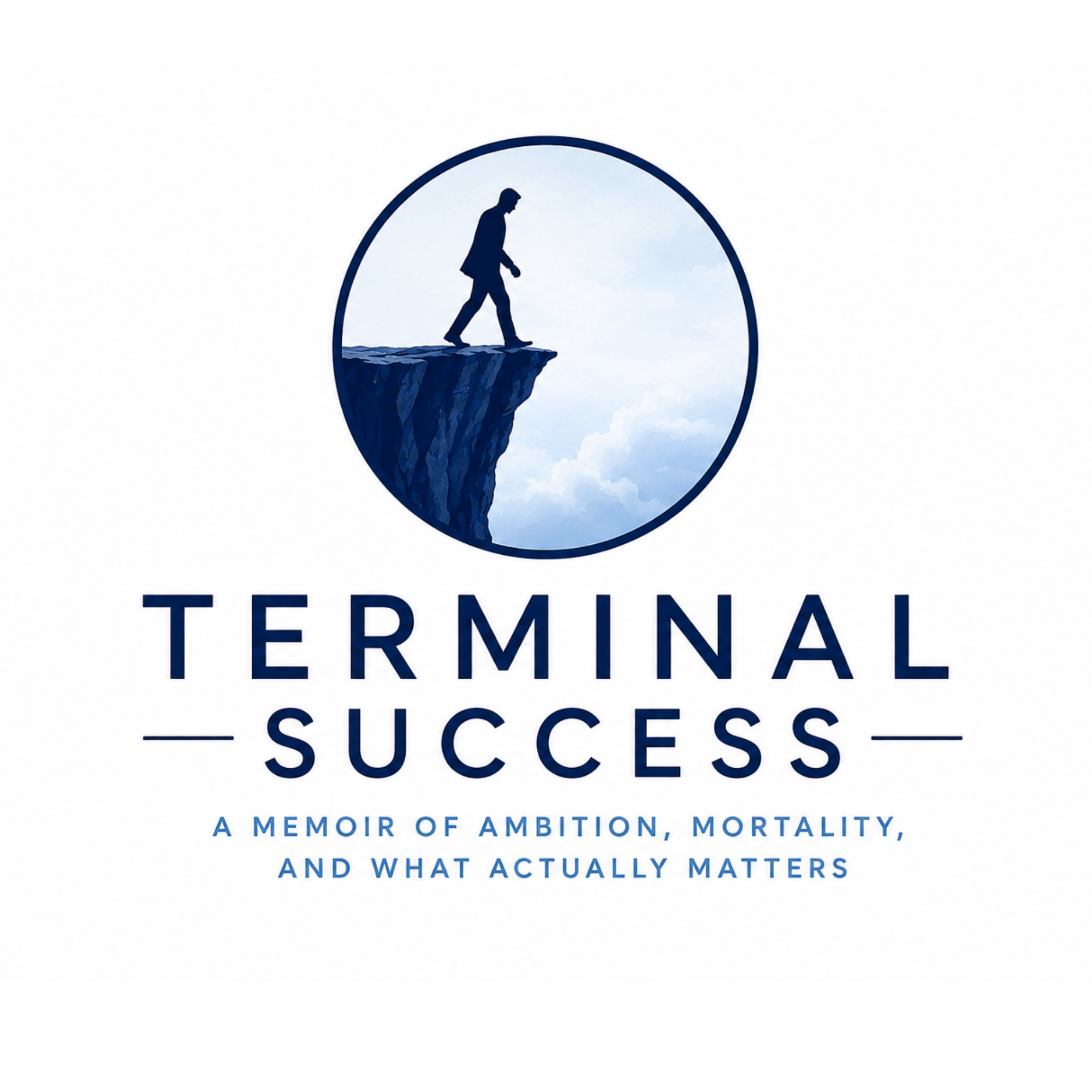
I write about this in Terminal Success by Jason Mandel — not because I want to frighten anyone, but because I believe the reckoning I was forced into is one that most driven people are quietly avoiding. You do not have to wait for a crisis to ask the question. The question is available to you right now: what is success actually costing me, and is that a trade I would make with full awareness?
The Specific Things That Feel Empty — And Why
When people describe the emptiness of success, they often struggle to name what, exactly, is missing. It feels vague. Diffuse. Like a low hum of something wrong rather than a specific identifiable problem. This vagueness is itself a symptom — because what's missing is not a thing that can be purchased or promoted into. What's missing is meaning. And meaning, unlike achievement, is not produced by effort directed outward. It comes from depth, from connection, from the feeling that what you are doing matters beyond the transaction of it.
The first thing that tends to feel hollow is the work itself. Not because the work is bad — often it is genuinely excellent work — but because the relationship to it has changed. Early in a career, there is discovery. There is novelty. There is the pleasure of getting better at something and the genuine excitement of not yet knowing how far you can go. Decades in, much of that is gone. What remains is mastery without surprise — the functional execution of things you have done a thousand times before. Competence without curiosity is a slow kind of death, and many successful people are living it while calling it stability.
The second thing that hollows out is relationships. Not dramatically — there is rarely a single moment of rupture. It is a gradual withdrawal of presence. You are physically there for the dinners, the events, the conversations. But you are not really there. Your mind is still at work. Your phone is still a gravitational pull. You are performing the role of spouse, parent, friend — performing it competently, even warmly — while the actual experience of connection bleeds away. People in your life may feel it before you do. They may stop expecting you to really show up, and that accommodation — that quiet lowering of expectations — is one of the saddest things that happens in the life of a driven person.
The third thing is identity. For a high achiever, identity and achievement are often fused so completely that the person cannot tell where one ends and the other begins. Your worth is your output. Your value is your title. Your self-concept is built almost entirely on what you have produced and accumulated rather than on who you actually are as a human being. This fusion works fine during the climb. It becomes a crisis when the climb slows — when the promotions stop, when the business plateaus, when illness or age or circumstance removes the achievement from the equation. Without the achievement, who are you? That is not a rhetorical question. For many people at the top of their fields, it is a terrifying one.
What I Wish Someone Had Told Me Twenty Years Earlier
I've thought a lot about what I would have needed to hear — really hear, not just process intellectually — at the height of my drive. The truth is that some lessons cannot be taught. They can only be earned. But I also believe that hearing the right words at the right moment of readiness can sometimes accelerate what would otherwise take a decade of painful accumulation. So I'll say what I wish someone had said to me.
The first thing is this: the hunger you feel is not your enemy. The restlessness, the drive, the refusal to be satisfied — these are real capacities, and they have real value. The problem is not that you have them. The problem is that they have been aimed exclusively at the wrong targets for a very long time. When that hunger is directed only toward career metrics, it becomes a machine that runs on a fuel that is never quite enough. When it is redirected — even partially — toward depth of relationship, toward genuine curiosity, toward understanding what you actually believe rather than performing what is expected of you — it becomes something nourishing rather than consuming.
The second thing is that slowing down is not failure. I know that sounds obvious. I know you've heard some version of it before. What I'm telling you is that I understood it intellectually for years before I understood it in my body — before I actually felt the difference between a day spent in frantic productivity and a day spent in real presence. The productivity felt urgent and important. The presence felt slow and sometimes uncomfortable. But the presence was where the life actually was. The productivity was the performance of a life. These are not the same thing, and the gap between them is where the unhappiness lives.
The third thing — the one that took the longest to accept — is that no amount of external achievement will resolve an internal question. The question of whether you are enough, whether your life has mattered, whether you are living in alignment with something true about yourself — these are not questions that a promotion or a net worth or a company valuation can answer. They are answered, slowly and imperfectly, by the choices you make about how to spend your attention. Attention is the only real currency. Everything else is a proxy.
The Reframe That Actually Changes Things
I want to be careful here, because the reframe I'm about to offer is not a comfort. It is not a soft landing. It is, in my experience, the most uncomfortable truth a high achiever can sit with — and also the most liberating one once it actually lands.
Success, as most driven people have defined it, is a destination. It is the thing you are moving toward. The entire architecture of a high-achiever's life is built around forward motion — the next goal, the next level, the next proof. This orientation is not wrong. It is how remarkable things get built. But it is catastrophically incomplete as a framework for a human life, because a human life is not a project with a completion date. It is an experience that is happening right now, continuously, and the only place it can actually be felt and inhabited is the present moment that you are currently sprinting past on your way to somewhere else.
The reframe is not to stop achieving. It is to stop believing that achievement is where the meaning lives. Meaning lives in the texture of ordinary days — in the conversation you are fully present for, in the work you do with genuine curiosity rather than anxious output, in the moments when you are not performing competence but actually experiencing your own life. These moments are available to you right now. They do not require a diagnosis, a crisis, or a retreat. They require only a decision — made daily, made imperfectly, made with full awareness that the old habits will pull hard against it.
In Terminal Success by Jason Mandel, I tried to document that decision honestly — not as a triumphant transformation but as a slow, often clumsy renegotiation with a self that had been running on the wrong operating system for decades. The renegotiation is ongoing. I do not have it fully figured out. What I have is a much clearer sense of what the question is — and that clarity, it turns out, is worth more than any answer I spent twenty years chasing.
A Different Measure of a Life Well Spent
If the measure of success you've been using isn't working — and if you're reading this article, it probably isn't — then the obvious question is: what would work instead? What would a different scorecard actually look like? This is where most self-help content offers you a list, a framework, a five-step process. I'm not going to do that, because I don't think the answer is a framework. I think it is a practice — and a deeply personal one.
What I can offer is the questions I started asking myself when the old metrics stopped being enough. Not as a checklist but as a genuine inquiry that I returned to, day after day, until the answers started to feel honest rather than performed. The first question: what did I do today that I was actually present for — not physically present, but genuinely there, aware, engaged? The second: who in my life do I actually know right now, versus who I am maintaining a relationship with out of habit or obligation? The third: if I knew this was one of my last years, what would I stop doing immediately? And the inverse: what would I start?
These questions are not comfortable. They are designed to produce friction, because friction is the signal that something real is being touched. The comfortable questions are the ones that confirm the story you're already telling yourself. The useful ones are the ones that make you pause, look away from the screen, and sit with an honest discomfort for a minute before your brain rushes in to explain it away.
I believe the most successful people — genuinely successful, by any measure that actually holds up under pressure — are the ones who eventually learn to tolerate that discomfort. Not to resolve it, not to optimize it, but to sit in it long enough to hear what it is actually saying. The discomfort is not the enemy. It is the tutor. And it has been waiting, patiently, for you to stop running long enough to attend the lesson.
Frequently Asked Questions
Why do I feel unhappy even though I'm successful?
The most honest answer is that the version of success you've been pursuing was designed to solve an external problem — status, security, recognition — but the unhappiness you're feeling is an internal one. No amount of external achievement permanently resolves the internal question of whether your life has meaning, whether you are truly known by the people you love, or whether what you are doing with your finite days is aligned with what you actually value. The unhappiness is not ingratitude. It is not a malfunction. It is your life asking you, with increasing urgency, to look somewhere other than your resume for the answer to the question that really matters.
Is it normal to feel empty after achieving your goals?
Not only is it normal — it is almost universal among people who have spent years in high-achievement cultures. Psychologists have a name for it: post-achievement depression or arrival fallacy. The brain is wired to motivate through anticipation. Once the goal is reached, the anticipation disappears, and what's left can feel strangely flat. The problem is compounded when achievement has been the primary source of identity and self-worth, because landing at the goal means losing the thing that made you feel most alive. Understanding that this is a structural feature of the achievement mindset — not a personal failure — is the first step toward building a relationship with yourself that doesn't depend entirely on the next milestone to feel okay.
Can success cause depression?
Yes — and this is something the culture around achievement rarely discusses honestly. There is substantial research linking high-achievement environments to elevated rates of anxiety, depression, and burnout. Part of this is biological: the stress hormones that fuel high performance take a serious toll on the body and brain over time. Part of it is psychological: identities built entirely on performance are inherently fragile, because performance is subject to forces outside your control. And part of it is existential: people who have spent decades achieving without asking why are often confronted, eventually, with a profound and disorienting emptiness that clinical depression can be one symptom of. If you are struggling, please speak to a mental health professional. What I share here is a perspective, not a treatment.
How do I find happiness after achieving my goals?
The most important reframe I can offer is this: stop looking for happiness as a destination you arrive at after the next achievement. Happiness — or more precisely, a sense of meaning and aliveness — is found in the texture of ordinary days lived with genuine presence and intentionality. That means investing in relationships with the same seriousness you've invested in your career. It means finding work that connects to something larger than the transaction. It means sitting with uncomfortable questions about what you actually value, not what you were trained to value. It is slow work, and it does not have a finish line. But it is the work that actually makes a life feel like a life rather than a very impressive performance of one.
Why does success feel meaningless?
Because meaning and success, as our culture defines them, are not the same thing and do not automatically overlap. Meaning comes from connection — to other people, to a sense of purpose larger than personal gain, to the feeling that what you are doing matters in some way that would persist even if no one were watching or rewarding you for it. Success, in the transactional sense, is about external validation and measurable output. These can coexist, and in the best cases they do. But they do not coexist automatically. If you have built extraordinary external success without ever asking the question of meaning, the success will eventually feel hollow — not because it isn't real, but because it was never designed to carry the weight of the deeper question you are now asking.
What Comes After the Question
I want to end not with a resolution but with an invitation — because that is where I actually am, and honesty matters more to me than a tidy conclusion. The question of why you are successful but unhappy does not have a clean answer that you can implement over a weekend and move past. It is a question you will return to, in different forms, for the rest of your life. And that is not a problem. That is the beginning of a different kind of engagement with your own existence — one that is less about accumulating proof and more about actually inhabiting the time you have.
What I know from my own experience is that the willingness to sit with the question — without rushing to fix it, optimize it, or delegate it — is itself a form of progress. The person who can acknowledge "I have built something impressive and I am not sure it is the life I actually want" is already several steps ahead of the person who cannot yet say that out loud, even to themselves. The acknowledgment is not weakness. It is the most sophisticated thing a driven person can do: to bring the same honest intelligence you have applied to your career to the question of your own life.
That is the work that nobody promotes you for. There is no year-end bonus for doing it well. The return on investment is measured in a currency that doesn't appear on any statement. But it is, in my experience and in the experience of everyone I have ever known who has done it seriously, the highest-yield work there is. Not because it produces more success by the old definition — but because it produces something the old definition never could: the feeling, however imperfect and however hard-won, that you are actually here. Present in your own life. Alive to it. No longer running past it on the way to somewhere else.
That feeling, it turns out, was available the whole time. The cost of finding it was simply the willingness to stop long enough to look.