The Moment Everything Rearranged Itself
There is a specific kind of silence that fills a room when a doctor delivers news you were not prepared to hear. It is not a peaceful silence. It is the silence of every assumption you have ever made about your life suddenly becoming suspect — the plans you were certain about, the things you kept telling yourself you would get around to eventually, the relationships you had been meaning to tend more carefully. In one sentence, all of it shifts. Not metaphorically. Literally. The ground you were standing on reveals itself to be less solid than you believed, and you are left there holding a conversation that will divide your life into before and after.
I know that silence. I sat in it. And what I did not expect — what nobody could have warned me about — is that surviving it would turn out to be more disorienting than receiving the diagnosis itself. Because the diagnosis at least gave me a target. It gave me something to fight. But surviving? Surviving gave me a question I could not outrun: now that you are still here, what exactly are you going to do with that?
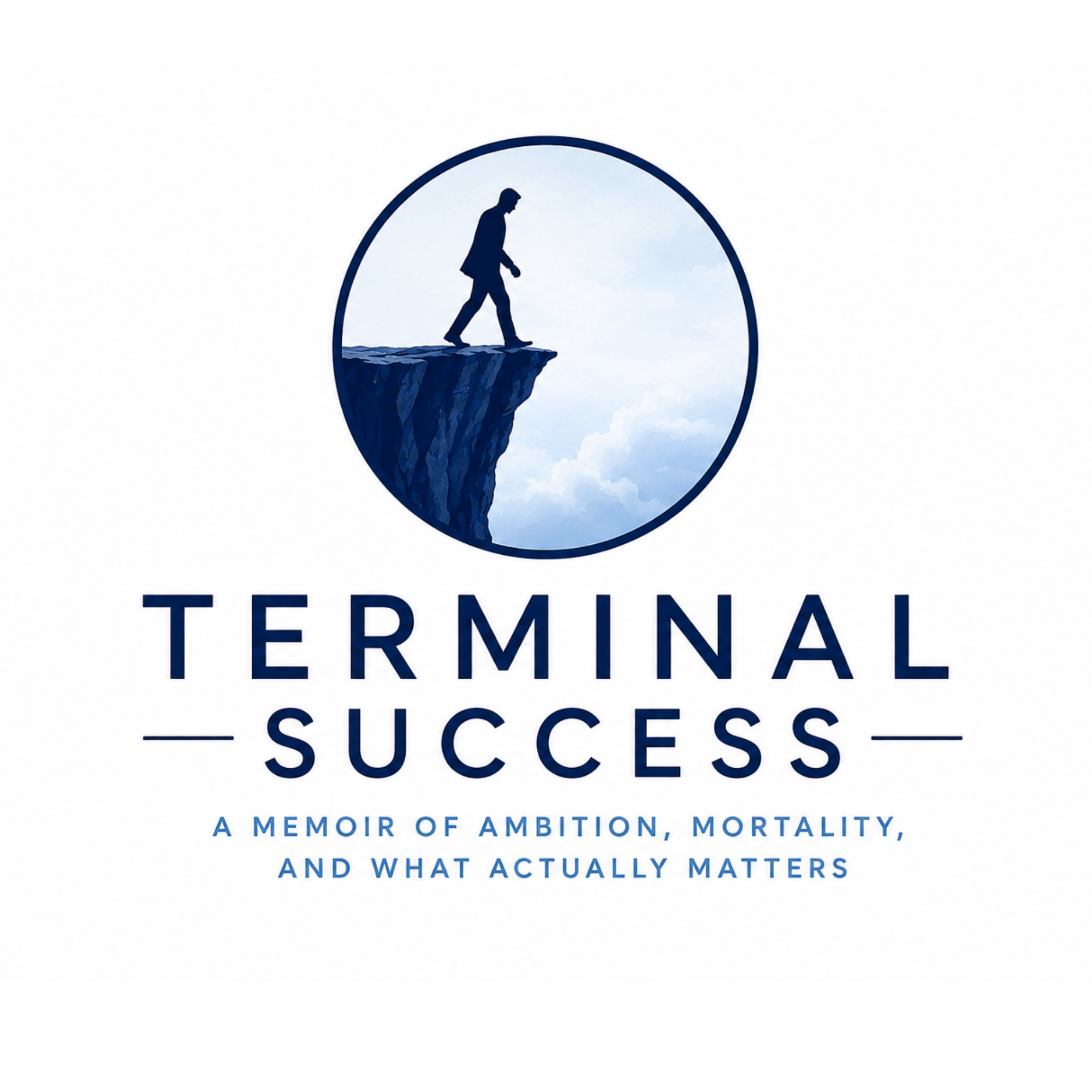
That question is still the most important one I have ever been asked. And it was not asked by a therapist or a mentor or a book. It was asked by my own life, quietly and persistently, every morning after I came out the other side. It is the question I wrote about in Terminal Success by Jason Mandel. And it is the question I want to sit with you inside today, because if you are reading this — whether you are a survivor yourself, or someone who has watched illness upend someone you love, or simply someone with a growing unease that the life you are building might not actually be the life you want — then this question belongs to you too.
Before the Diagnosis: The Story I Was Telling Myself
I had built something real. A career on Wall Street that started from nothing and grew into something that most people in my world would have recognized as success. Long hours, serious money, the kind of credentials that open certain doors and close others. I was proud of it, genuinely. I am not going to pretend I was secretly miserable the whole time, because that is not the truth. I worked hard at something I was good at, and for a long stretch, that felt like enough. It felt like it was supposed to feel.
But there was a story I was quietly telling myself beneath all of it — one of those stories you do not examine too closely because examining it might require you to change something. The story went like this: work hard now, accumulate now, sacrifice now, and eventually the real life begins. The life where there is time for the things that actually matter. The life where you are not always behind, not always on, not always one email away from something urgent. That life was always six months away, or maybe a year, or maybe after the next deal closed or the next goal was reached.
I think a lot of high achievers live inside some version of this story. It is not laziness and it is not cynicism — it is actually a kind of optimism, in a strange way. You believe the future version of your life will be better, richer, more present, more meaningful. You believe that the current pace is temporary and that the real rewards are coming. The problem is that the future version never quite arrives, because the moment you reach the milestone you were aiming for, there is always a new one forming just ahead of it. The horizon moves as you move. The real life keeps getting deferred.
I did not understand how completely I had bought into this story until the story got interrupted. Until something happened that the story had no framework to contain. Because a cancer diagnosis does not care about your five-year plan. It does not negotiate with your timeline. It simply lands, and suddenly the distance between now and eventually collapses into something uncomfortably small.
What the Diagnosis Actually Did to Me
I want to be careful here, because I have read enough accounts of illness that flatten the experience into something neat and instructional — the kind of thing where a person gets sick, learns a lesson, and then shares it in a way that makes the whole ordeal sound almost tidy. That is not what this was. It was not tidy. It was frightening and disorienting and full of moments where I did not know what I was supposed to feel. I was scared in ways I had never been scared before, and I was also, underneath the fear, strangely awake in a way I had not been in years.
That wakefulness is the thing I was not prepared for. When you are facing something with real stakes, when the outcome is genuinely uncertain, there is a kind of noise that falls away. The low-grade static of a thousand small anxieties — the worry about whether someone respected you in a meeting, the frustration about a deal that did not close the way you wanted, the background hum of ambition and comparison that most ambitious people carry without even noticing it — all of that went quiet. What remained was a much smaller and much more honest list. The people I loved. The things I wished I had said. The time I had spent on things that no longer seemed worth the hours I had given them.
This is not a unique experience. Ask almost any serious illness survivor and they will describe something like this — a sudden clarification, an involuntary audit of what actually matters. But what I found interesting, and what I think gets underdiscussed, is that this clarity does not automatically translate into change. Knowing what matters and actually reorganizing your life around what matters are two completely different things. And the gap between those two things is where most survivors eventually find themselves stranded, once the immediate crisis passes and the ordinary world reasserts itself with all its old demands.
The Return: When the World Expected the Old Version of You
Nobody tells you about the reentry. That is the word I kept using in my own head — reentry, like coming back from somewhere so far away that the atmosphere on return creates its own kind of friction. You come through treatment, you get a prognosis that lets you breathe again, and then the world — your colleagues, your clients, your calendar, your inbox — starts asking for the old version of you. And it is not malicious. People just resume their patterns. They were waiting for you to get better, and now that you are better, the expectation is that you will slide back into your previous shape.
But you do not fit that shape anymore. Or at least, I did not. The hours that once felt like just the cost of doing business now felt like a specific choice — a choice to be somewhere other than where I actually wanted to be. The meetings that used to feel important felt, in many cases, like theater. The urgency that had driven so much of my professional life revealed itself as largely manufactured — the sense that everything was critical and nothing could wait was not an objective description of reality. It was a culture. A shared agreement. And once you have stepped outside of that culture, even briefly, you can see it from the outside in a way you cannot see it from the inside.
I started asking questions I had not asked before, and not in a dramatic or performative way. Quietly, privately, almost reluctantly — because I had worked hard to build what I had built and I was not eager to dismantle it. But the questions would not stay quiet. Is this the best use of the hours I have? Is this the version of my life I would look back on and feel at peace with? Am I here because I genuinely choose to be here, or because I built something so tall that the cost of climbing back down feels too high? These are uncomfortable questions. They do not have comfortable answers. But they are honest ones, and I think a lot of people who have faced serious illness arrive at them eventually whether they want to or not.
Does Surviving Cancer Change Your View of Success? Honestly, Yes. But Not in the Way You Might Expect.
The popular narrative about illness and success goes something like this: person gets sick, person realizes money and achievement do not matter, person quits their job and moves to a cottage and grows vegetables. That is a real story for some people, and I respect it completely. But it was not my story. What changed for me was not the destination — it was the question I was willing to ask about the destination. And that is a subtler shift, but in many ways a more durable one.
I did not walk away from ambition. I do not think ambition is the problem. What I walked away from was the unconscious version of ambition — the kind that runs on autopilot, that never pauses to ask whether the goal is actually connected to anything you genuinely value, that treats achievement as its own justification. The kind of ambition where you cannot explain why you want the next thing, only that you want it, only that stopping would feel like failure. That version of ambition I left behind. And what I found on the other side of it was something quieter and, honestly, more sustainable. Intentional ambition. Chosen goals. A willingness to ask, before spending time on something, whether I would still think it was worth it if I knew in advance how much time it was going to cost me.
That recalibration is slow. I want to be honest about that. It does not happen overnight, and it is not permanent in the sense of being effortless. The old patterns have gravity. The culture of overwork and constant availability pulls at you. The comparisons to peers who seem to be accumulating faster, advancing further, achieving more — those comparisons do not disappear just because you have had a health scare. What changes is your relationship to them. They lose their authority. You can hear them, register them, and then set them aside in a way that was not available to you before the diagnosis rearranged your inner landscape.
What I Learned About Time That I Cannot Unlearn
Time is the resource that illness makes undeniable. Not in the abstract — we all know intellectually that we are finite, that the clock is running, that no one gets out of this alive. That knowledge sits in the background of almost every adult life. But a cancer diagnosis moves that knowledge from the background to the foreground. It makes the abstraction concrete. And once it is concrete, once you have felt it rather than merely known it, you cannot un-feel it. The awareness stays with you.
What I noticed, once that awareness settled in, is how much of my life had been organized around the assumption of abundance. Abundance of time, specifically. The assumption that there would always be more — more mornings, more dinners, more conversations that got postponed, more trips that were going to happen someday, more of all the things I was not quite getting around to. That assumption had been quietly running everything. Every deferral was built on it. Every "not now, but soon" was a bet placed on the continued availability of future time. And the diagnosis called that bet. It sat across from me and said: how certain are you, exactly, that soon is available?
I started treating time differently after that. Not in a manic way — not running around trying to compress every experience into every day, not posting inspirational content about living fully. More quietly than that. More practically. I started asking, before committing to something, whether I would choose it if I could see clearly how much of my remaining time it would cost. I started noticing the things I kept deferring and asking myself what I was actually waiting for. I started taking the "someday" items seriously — not all of them at once, but one at a time, with a real decision about whether someday was actually going to happen or whether I was just carrying the fiction of it to avoid the grief of letting it go.
That last part is worth saying plainly: some of the things we defer are things we genuinely intend to do. But some of them are things we know, on some level, we are never actually going to do — and we keep them on the list because removing them would require us to acknowledge a loss. Illness has a way of stripping that fiction away. It forces a kind of honesty about the list that is uncomfortable and also, ultimately, clarifying. What remains after you have been honest is a shorter list. But it is a real one.
The Career Question Nobody Prepares You For After Cancer
Returning to work after a serious illness is one of the least-discussed transitions in professional life. There is some conversation about the logistical side — the accommodations, the schedule adjustments, the physical realities of recovery. But there is almost no honest conversation about the identity question that comes with it. Because for a lot of high-achieving people, career is not just what they do. It is a significant part of how they understand themselves. It is where they feel competent, recognized, purposeful. And a serious illness does not just threaten your body — it threatens the scaffolding of identity that your career has been quietly holding up.
When I came back to work, I was the same person in most of the ways that matter. My skills were intact. My knowledge was intact. My relationships were intact. But my investment in the performance of success — the part where you prove something to others or to yourself by how hard you work and how much you accumulate — that had shifted underneath me. I could still do the work. What I could not do anymore was pretend the work was the whole thing. Could not pretend that billing more hours or closing more deals was a sufficient answer to the question the illness had asked. And that gap, between what the professional world was asking of me and what I actually had to offer it, was real and had to be navigated honestly.
What I found is that most workplaces, and most professional cultures, are not equipped to support that navigation. Not because the people in them are unkind — in most cases they are not. But because the culture of high-performance professional environments is built on a certain kind of forward momentum that does not make space for reflection. The expectation is that you get healthy and you come back and you pick up where you left off. And the pressure to comply with that expectation is real, especially if your identity has been tangled up in being competent and reliable and high-functioning. The last thing a high achiever wants is to appear diminished. The last thing they want is for the illness to show in their work. And so there is a tendency to overcorrect — to push harder than necessary, to prove that nothing has changed, to perform a recovery that may or may not accurately reflect what is actually happening on the inside.
What Survivors Wish They Had Known Earlier
I have had conversations, since my own experience, with other people who have come through serious illness and returned to demanding professional lives. What strikes me in nearly every conversation is a version of the same regret, articulated in different ways. The regret is not usually about the work itself. It is not about having worked hard or built something real. The regret is more specific than that. It is about the trade. The thing they gave up in exchange for the achievement, and whether, knowing what they know now, they would make that same trade again.
Almost universally, the answer is no. Not because the work was not worthwhile — in most cases it was. But because the trade was never fully conscious. They were not sitting down and saying: I am choosing to miss this so that I can have that. They were just moving, following the current of expectation and ambition and habit, and the things that mattered were quietly getting left behind in the wake without anyone formally deciding to leave them. The illness, in many cases, is the first moment they stopped moving long enough to look back and see what the current had carried away.
What they wish they had known earlier is simple, but it is also the kind of thing that is almost impossible to fully absorb from the outside. They wish they had known how fast it goes. Not in the bumper-sticker sense — everyone knows life is short. But in the specific, cellular sense of sitting at sixty and realizing that the child you were going to be more present for is now grown, or the relationship you were going to invest more in has calcified into a polite distance, or the part of yourself you were going to return to once things settled down has become so unfamiliar it barely feels like yours anymore. They wish they had known that the future they were planning around was not as reliable as they assumed. And they wish, almost all of them, that they had asked the harder questions earlier — before an illness forced the questions on them.
The Unexpected Gift Hidden Inside the Hardest Thing
I want to be careful not to romanticize illness. It is not a gift. It is not something to be grateful for in the way you might be grateful for a good piece of advice or a well-timed intervention. It is frightening and it is painful and it takes things from you that it does not give back. I am not interested in the version of this story where the cancer was secretly a blessing in disguise. That framing dishonors the reality of what it actually is.
But I do think there is something real inside the experience that I would not trade now, even though I would have traded the experience itself if I could have. That thing is clarity. A specific, hard-won clarity about what I actually value, what I am actually afraid of losing, and what I had been treating as important that turns out, under examination, to be mostly noise. That clarity is not comfortable. It does not make every decision easier. But it makes the important decisions harder to avoid. It makes the questions more honest. And in a life that had been, in many ways, organized around avoiding the most honest questions, that matters more than I can easily say.
In Terminal Success by Jason Mandel, I tried to write honestly about this — about what it actually felt like to have built something real and then be forced to ask whether it was the right thing to build, whether the costs were the right costs, whether the version of success I had been pursuing was one I had ever consciously chosen or simply one I had inherited from the world I grew up in. Those questions did not have clean answers. They still do not. But the willingness to ask them changed something fundamental about how I move through my life, and I think for a lot of people — not just illness survivors, but anyone who has reached a point where the achievements have arrived but the satisfaction has not — those questions are worth asking before you have no choice.
Frequently Asked Questions
How does cancer change your priorities?
Cancer does not change your priorities in the sense of installing new ones from outside. What it does is strip away the distance between what you say matters and what you actually treat as though it matters. Before a serious diagnosis, most people carry a significant gap between their stated values and their lived choices. They say family matters most, but they are working until ten o'clock. They say they want to be present, but they are halfway somewhere else in every conversation. A cancer diagnosis closes that gap — not always permanently, but long enough to see it clearly. The priorities were always there. What changes is the honesty about whether you were actually living them.
Does surviving cancer change your view of success?
In my experience, yes — but not in a single dramatic moment of revelation. It is more gradual than that, and more personal. What shifts is the framework you use to evaluate decisions. Before illness, the framework most high achievers use is heavily weighted toward accumulation and advancement — more revenue, more recognition, more progress toward the next defined goal. After surviving something serious, that framework does not disappear, but it loses its monopoly. Other frameworks start to feel equally legitimate: Is this sustainable? Is this costing me something I will mourn? Am I choosing this, or just continuing it because changing it is hard? Success does not become meaningless. It becomes more specific. And the specificity is harder and more honest than the general version you were working with before.
How do you return to work after cancer?
The honest answer is that returning to work after cancer is not a single transition — it is a series of them, and they happen at different speeds. There is the physical return, which most people manage with some combination of accommodation and determination. And then there is the internal return, which takes longer and often goes unaddressed. The internal return involves renegotiating your relationship to the work — asking what you are still willing to give it, and what, going forward, you are not. That negotiation is uncomfortable in professional environments that do not make space for it. My advice to anyone going through it is to resist the pressure to simply recreate the old version of your professional self as quickly as possible. That version served a purpose, but you have information now that version did not have. Use it.
What do cancer survivors learn about life?
The most consistent thing I have heard from survivors, and experienced myself, is an acute awareness of how much of daily life is spent in a kind of automatic mode — reacting, complying, performing, moving through days without ever fully choosing them. Illness interrupts that automatic mode. It forces a kind of presence, however uncomfortable, that most people do not encounter until something strips it into necessity. What survivors learn is that the presence is possible — that it is not only available in crisis, not only accessible when something is at stake. It can be chosen. It can become a practice. The lesson is not dramatic. It is almost embarrassingly simple. Be here. Actually here. Not managing here, not performing here, not planning ahead from here — but genuinely, actually present in the life that is happening right now. That sounds easy. It is not easy. But it is worth every effort it requires.
What This Means for You, Whether You Have Been Sick or Not
I want to end here, with you — specifically with you, if you are reading this without having faced a serious illness, because in some ways this conversation is most urgent for exactly that person. The person who is still inside the story, still assuming the future is as available as it has always felt, still planning to get around to the important things once the current urgency settles. That is the person I most want to reach, because that was me, and because I had to be forced into the questions I should have been asking all along.
You do not have to wait for the diagnosis. You do not have to wait for the silence in the doctor's office to start asking what you are actually trading your hours for, and whether, knowing what you know about yourself and what you genuinely value, you would make those trades again. You do not have to wait for the interruption to get honest about the story you are telling yourself. The questions are available now. The clarity is available now. It is harder to access without the crisis to force it — I understand that, because I needed the crisis. But it is available. And the version of you who starts asking those questions today is so far ahead of the version who waits until the questions become unavoidable.
That is what I carry from everything I went through. Not a prescription, not a program, not a ten-step plan to live more meaningfully. Just the knowledge that the questions are worth asking, and that asking them early, voluntarily, with the curiosity of someone who genuinely wants to know the answers rather than the desperation of someone who has no choice — that is one of the most important things a person can do with however much time they actually have.