How Do You Return to Work After Cancer? The Identity Crisis No One Prepares You For

The Question Nobody Thinks to Ask Until They're Living It
There's a moment they don't show you in the pamphlets. It's not the diagnosis, as shattering as that is. It's not the treatment, as brutal as that can be. It's not even the day they tell you the worst is behind you, though that day carries its own complicated weight. The moment I'm talking about comes later — sometimes weeks later, sometimes months — when the world expects you to simply walk back through the door you left, sit down at your desk, and pick up where you left off. As if nothing happened. As if you aren't a fundamentally different person standing in the wreckage of who you used to be.
That moment — the return — is the one nobody prepares you for. And for many survivors, it becomes the hardest part of the whole experience. Not because the work itself is impossible. But because you discover, standing at the threshold of your old life, that you no longer recognize the person who used to live there. The calendar says you've been gone three months. Your body says you've aged ten years. And somewhere deep in the place that illness has a way of excavating, your soul is asking a question that every high achiever eventually has to face, just rarely this soon, rarely this nakedly: Who am I without all of this?
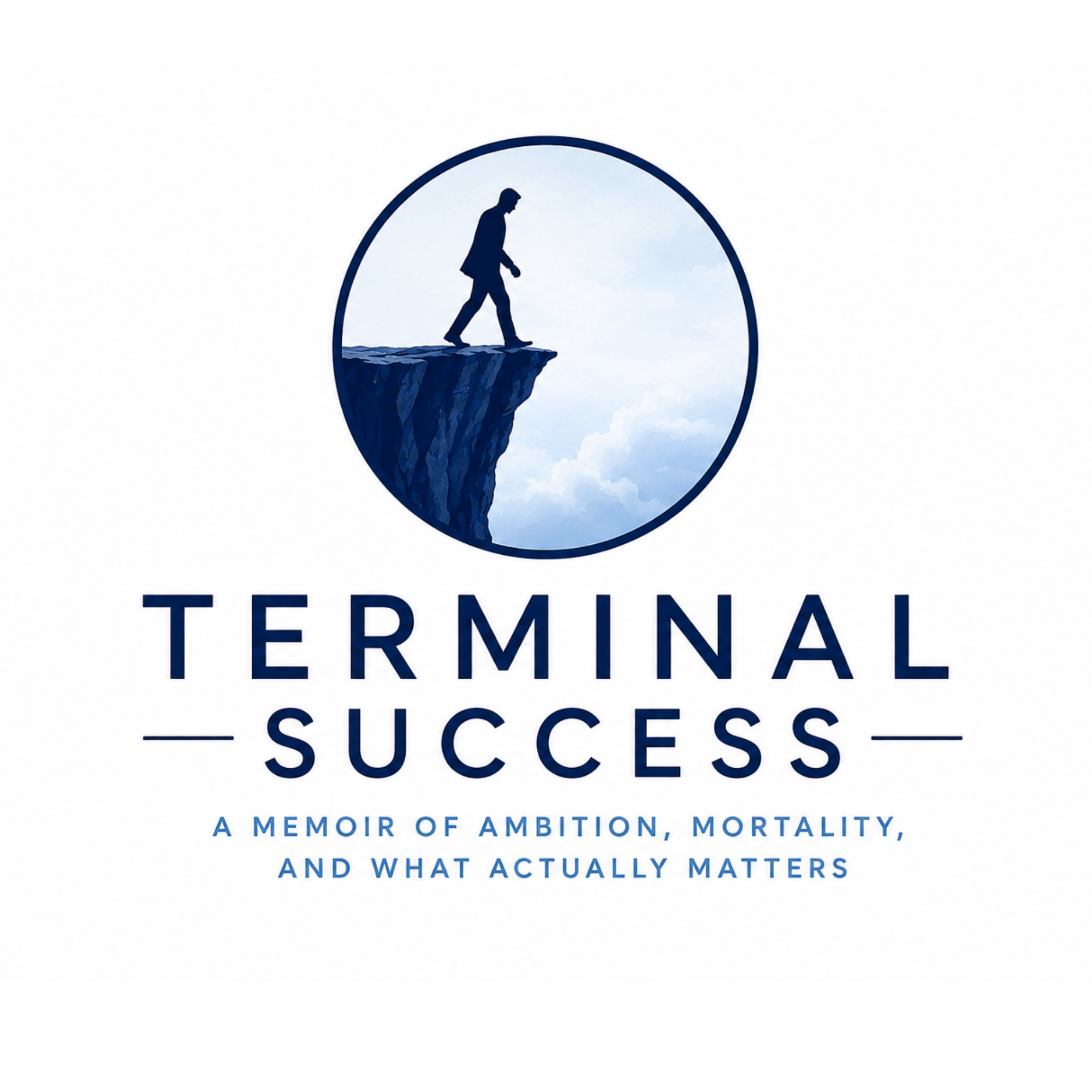
I've been in that moment. I know its particular silence. Before my health crisis forced me to stop — really stop, not the performative kind of rest high achievers reward themselves with between sprints, but a full, humbling, involuntary stop — I was the person who defined himself entirely by what he produced. I was my deal flow. I was my hours. I was my title, my firm, my output. And then illness arrived, and stripped all of that away like paint off a wall, revealing what was underneath. Some of what I found underneath surprised me. Some of it disturbed me. All of it changed me in ways I'm still understanding. I wrote about much of that reckoning in Terminal Success by Jason Mandel — available on Amazon at https://www.amazon.com/dp/B0GTZNZBSZ — because I believe the experience of nearly losing your life is one of the most clarifying forces a human being can encounter, and almost no one talks honestly about what it actually does to your relationship with work, identity, and purpose.
The Lie We're Told About Recovery
The medical system, for all its brilliance and lifesaving precision, is built around a binary: sick and not sick. You are in treatment, or you are recovered. You are a patient, or you are a person again. The moment your scans come back clean, the moment you are discharged, the moment your doctor shakes your hand and says "you're good to go," the system considers its job complete. And in a narrow, clinical sense, maybe it is. But no one in that office is thinking about what happens on Monday morning when you drive back into the parking garage where you used to park every day, ride the elevator, walk past colleagues who smile too carefully because they don't know what to say, and sit down at a desk that smells exactly the same as it did before everything changed. No one is preparing you for that.
The lie we're told — or more accurately, the lie we're allowed to believe because no one corrects it — is that returning to work means returning to normal. It doesn't. It can't. You have been through something that permanently rewires the way you experience time, priority, risk, and meaning. You have stared at your own mortality in a way that most of your colleagues haven't. You've had hours — long, slow, medicinal hours — to think about things you were too busy to think about before. The very busyness that used to protect you from those thoughts has been stripped away, and now you're left with the uncomfortable clarity that illness forces on everyone it visits. Returning to work doesn't undo that clarity. It collides with it.
What makes this particularly disorienting for high achievers is the expectation — internal as much as external — that you will bounce back. High achievers are built around a narrative of resilience. We don't stay down. We adapt. We push through. The same drive that got us into the corner office tells us that recovery is just another performance metric to optimize. So we return to work earlier than we probably should. We smile more than we feel. We say we're fine because saying otherwise feels like losing ground. And then we sit at our desks wondering why we feel like strangers in our own lives, wondering why the urgency that used to animate our work has gone flat, wondering whether there's something wrong with us for not wanting what we used to want so desperately.
When the Work Stops Making Sense
Here is what I know from the other side of that experience: the work doesn't stop making sense because something is wrong with you. It stops making sense because something is finally right. For most driven people, the relationship with work has never been entirely healthy. We don't admit this, because the culture rewards our pathology. The sixty-hour week is celebrated. The deal closed from the hospital waiting room is a badge of honor. The vacation spent checking email is expected. We have built entire professional identities around a definition of commitment that, looked at clearly, is just a sophisticated form of self-abandonment. Illness has a way of making that very clear, very fast.
When I was in the thick of my work life, I was obese, diabetic, and running on a kind of manic momentum that I mistook for passion. I was a workaholic, and the work was eating me alive in ways I wasn't willing to name. The gastric bypass surgery I eventually underwent at the Cleveland Clinic wasn't just a medical procedure — it was the beginning of a forced reckoning with everything I had been using work to avoid. The physical transformation was dramatic. But the internal transformation was the real story. Because when you change that profoundly at the level of the body, you cannot leave the soul untouched. You start asking questions that busyness had been answering on your behalf for years. Questions like: What am I actually building? Who is this life for? Is the person I've become someone I would have chosen to become, or did I just follow the path of least resistance in the direction of maximum reward?
Those are not easy questions to sit with. They are especially not easy to sit with in a conference room, surrounded by people who are operating under the old rules, moving at the old pace, chasing the old metrics. Returning to work after a health crisis doesn't just feel disorienting because you're physically depleted. It feels disorienting because you are now asking different questions than everyone around you. And in most workplaces, asking different questions makes you a problem to be managed rather than a perspective to be valued. So survivors often go quiet. They swallow the questions. They try to re-inhabit the old self. And they suffer for it in ways that don't have clinical names, but that anyone who has been through it will instantly recognize.
The Identity Crisis That Illness Reveals
The identity crisis that follows a serious illness isn't created by the illness. The illness just reveals it. For most high achievers, the identity crisis was already there, buried under the relentless forward motion of ambition. We had simply never been forced to stop long enough to see it. What illness does — what any serious mortality event does — is remove the noise. It removes the deadlines, the meetings, the performance reviews, the social comparisons, the LinkedIn updates, all of the scaffolding that we use to tell ourselves and each other who we are. And when all of that is gone, the question of who you actually are becomes unavoidable.
For many survivors, the answer to that question is deeply uncomfortable. Because what they find, in the quiet, is that they don't entirely know. They know what they do. They know what their title is, what their salary is, what their output looks like on a good quarter. But who they are — what they value, what brings them alive, what kind of presence they want to be in the lives of the people they love — those answers are surprisingly hard to find under all that achievement. And the return to work, rather than resolving this crisis, often intensifies it. Because you are being asked to recommit to an identity that illness has made you question, in a context that provides no space to process what you've been through.
I've seen this play out in my own life and in the lives of people I've known who've been through similar experiences. The survivor who goes back too soon and finds themselves crying in the parking garage before they can bring themselves to walk through the door. The executive who returns to full capacity on paper but cannot shake the feeling that something essential has been permanently altered. The professional who quits a job they used to love six months after returning, not because the job changed but because they did. These are not failure stories. They are stories of people whose capacity for self-awareness finally caught up with their capacity for achievement. The grief they're feeling isn't weakness — it's intelligence. It's the beginning of a more honest relationship with themselves and with their work.
What the Return Actually Requires
Returning to work after cancer or any serious illness isn't a logistical challenge. It is a philosophical one. And the people who navigate it best are not the ones who manage to re-inhabit their old identity most seamlessly. They are the ones who resist that pressure and allow the experience of illness to permanently inform the way they work, what they work toward, and why. That requires a kind of courage that doesn't come naturally to high achievers, because it is the courage to be changed — to let the experience actually do what it is trying to do, rather than powering through it like it's just another obstacle on the path to the next achievement.
The first thing worth understanding is that the timeline is not linear and it is not quick. The medical recovery and the psychological recovery operate on completely different schedules, and conflating them is one of the most common mistakes survivors make. You may feel physically capable of returning to work weeks before you are psychologically ready to reenter the identity pressures, interpersonal dynamics, and performance demands of your professional life. Giving yourself permission to acknowledge that gap — and to work with it rather than against it — is not weakness. It is the most practically intelligent thing you can do.
What compounds this further is the social dimension of returning. Colleagues don't know how to act around you. Some will overcompensate with cheerfulness that feels hollow. Some will avoid the subject entirely, which can feel like erasure. Some will project their own fear of illness onto you in ways that make you feel like a reminder of something they'd rather not think about. Very few will know how to simply be present with you in the reality of what you've been through. This is not cruelty — it is the ordinary human awkwardness around mortality. But navigating it on top of your own internal upheaval is genuinely exhausting, and survivors often report that the social complexity of returning is as draining as the work itself.
And here is where it gets uncomfortable: the people who return to work and actually thrive are rarely the ones who return unchanged. They are the ones who use the experience as a lens through which to make deliberate choices about what they will and won't do, what they will and won't tolerate, and what they are ultimately working toward. They renegotiate their relationship with their careers — not necessarily by quitting or dramatically downshifting, but by getting honest about which parts of their work genuinely matter and which parts are just habit, just status, just the well-worn groove of ambition that keeps moving forward because stopping to question it feels too dangerous.
The Gifts That Illness Gives, If You Let It
There is a conversation that I suspect most survivors have in some form, usually alone, usually in the dark hours when the mind won't quiet. It goes something like this: I was given more time. So what am I going to do with it? And the answer that comes back, when you're honest, is often not the one that aligns neatly with the calendar you'd been living by before. Illness recalibrates what you're willing to trade your finite hours for. It makes certain compromises suddenly impossible to make. It makes certain relationships suddenly too important to keep treating as secondary. It changes the math of how you allocate the one resource that every scan, every diagnosis, every prognosis has made viscerally real to you: time.
This recalibration is not a problem to be solved. It is the most valuable thing the experience has given you. The question is whether you will honor it or whether you will let the pressure of re-entry override it, let the gravitational pull of your old life drag you back into the patterns that were already costing you before you got sick. I know which choice leads where. I lived one of those paths and found it headed somewhere I did not want to go. The life I began building after my health forced me to reckon with my choices — the one away from the relentless chase, the one oriented toward what actually matters and lasts — is not the life I would have had the clarity to choose if I hadn't been stopped.
The gift of a mortality event is not that it makes you grateful for what you have, though it does that too. The deeper gift is that it makes you ruthlessly clear about what you don't want. It removes the patience you used to have for things that drain you without giving anything back. It removes the tolerance you had for performing a version of yourself that was built for other people's approval. It removes the willingness to postpone the things that matter in service of the things that are merely urgent. These are not small gifts. They are the kind of clarity that most people spend decades in therapy trying to find, and illness hands it to you, roughly and without ceremony, in the space of a hospital room.
Redefining What Work Is For
One of the most liberating and disorienting things about returning to work after a serious health crisis is the opportunity — and the pressure — to redefine what work is actually for in your life. For most of us, that question was never really answered. We followed a path: school, credential, job, ladder. We optimized within the system we found ourselves in. We told ourselves that the money was for security, the security was for freedom, and the freedom was always coming, just around the next corner, after the next raise, after the kids were through college, after we'd saved enough. Illness makes that deferral impossible to sustain. You can no longer pretend that the future will give you what you keep refusing to give yourself in the present.
Redefining work doesn't mean abandoning ambition. I want to be clear about that, because the self-help narrative around illness and meaning tends to flatten into something saccharine and unrealistic — the idea that surviving cancer means you should quit your job and go teach yoga in Costa Rica. That's not what I'm talking about. I'm talking about something more demanding: continuing to work at a high level while getting honest about whether the way you're working, the things you're working toward, and the cost you're paying to get there are actually in alignment with the life you say you want to live. That kind of honesty is harder than quitting. It requires you to stay in the arena and change the rules you play by, rather than leaving the game altogether.
What I've found, and what I've seen reflected in others who navigate this well, is that the survivors who thrive professionally are the ones who bring what illness taught them into their work rather than trying to keep it separate. They are more direct because they have less patience for pretense. They are more present because they understand viscerally that attention is finite. They are more deliberate about what they agree to because they know what it costs to give their energy away indiscriminately. They are, paradoxically, often more effective professionally because they've stripped away the noise and the ego-driven urgency that was wasting enormous amounts of their capacity before.
The Question Underneath the Question
When someone types "how do you return to work after cancer" into a search bar, they are rarely asking about logistics. They're not looking for a checklist of practical accommodations, though those can be useful. What they're really asking — the question underneath the question — is something closer to: How do I go back to a life that no longer fits the person I've become? How do I reconcile who I was before with what I now understand? How do I re-enter a world that hasn't changed when I have changed profoundly?
I don't think there is a clean answer to that question. I think there is only a process — the process of living your way into a new relationship with your work, your identity, and your time. It is slow. It is nonlinear. It involves grief as much as growth. It involves allowing yourself to not know, for a period, which parts of your old life are worth reclaiming and which are better left behind. It involves tolerating the discomfort of occupying two identities at once: the person you were before, who still shows up in certain rooms and certain habits, and the person you are becoming, who keeps asking inconvenient questions and refusing to be entirely satisfied by the old answers.
What I can tell you is that the question is worth sitting with. The disorientation you feel returning to work is not a malfunction. It is intelligence. It is your inner life catching up with what your body has already been through. The people who try to skip it — who power through and perform their way back to the old normal — often find themselves in crisis again later, because the questions that illness raises don't go away just because you stopped listening to them. They wait. And they get louder.
What No One Tells You About Who You Are Now
There is a passage in Terminal Success by Jason Mandel — available at https://www.amazon.com/dp/B0GTZNZBSZ — that I find myself returning to when I think about this experience. A man tells his stories so many times that he becomes the stories. The idea is that our identity is not a fixed thing — it's an ongoing narration. What illness does is interrupt the narration. It forces a revision. And the question is whether you will revise honestly or simply try to resume a story that no longer describes who you are.
The person who returns to work after a serious illness is not the same person who left. That is not a tragedy. That is the most important truth you can carry back through that door. The identity crisis that follows — the disorientation, the grief, the re-evaluation, the uncomfortable clarity — is not a sign that something went wrong. It is a sign that the experience did exactly what it was supposed to do. It cracked you open. It showed you what was underneath the achievement, the titles, the busyness, the beautiful, exhausting machinery of a life built for performance. And what you found there, however uncomfortable, is more real and more worth building toward than the persona you were maintaining before you got sick.
Returning to work is not about going back. It is about going forward — differently, more deliberately, with a clearer understanding of what you are actually working for and why. That clarity is the gift that illness gives to those who are willing to receive it. It will cost you something. The old version of yourself, comfortable in its familiar urgency, will resist. But the life on the other side of that resistance — the one that is built around what actually matters rather than what merely signals success — is the one worth all of the difficult work of becoming.
Frequently Asked Questions
How long does it take to feel normal at work after cancer?
The honest answer is that the timeline is different for everyone, and the concept of "normal" is itself worth questioning. Most survivors report that the physical adjustment to returning takes weeks to months, depending on the nature of the illness and treatment. The psychological and identity adjustment — the deeper sense of re-inhabiting your professional life with a new set of values and questions — can take much longer. A year is not unusual. Neither is two. What matters is not how quickly you get back to where you were, but whether the place you're getting back to is actually where you want to be. That is the harder and more worthwhile question.
Is it normal to feel like a different person after cancer?
Not only is it normal — it is one of the most commonly reported experiences among survivors, and it is in many ways the most valuable thing the illness gives you, even if it doesn't feel that way in the middle of it. A serious health crisis interrupts the story you've been telling yourself about who you are. It removes the noise and the motion that kept certain questions at bay. What you find in that quiet is often more real and more clarifying than anything you could have arrived at through ordinary experience. Feeling like a different person is not a problem to be corrected. It is the beginning of a more honest relationship with yourself.
Why do I feel unmotivated to return to work after cancer?
Because illness has recalibrated what you're willing to trade your energy for. The motivation you had before was tied to a set of priorities, a definition of success, an internal story about what mattered — and all of that has been permanently altered by what you've been through. The unmotivated feeling is not laziness. It is your psyche refusing to recommit to things that no longer genuinely call to you. Rather than forcing yourself back into the old motivation, the more productive question is: What would I actually be motivated by, if I allowed myself to answer honestly? That question, taken seriously, is the beginning of building a professional life that actually fits the person you are now.
What do cancer survivors wish they had known about returning to work?
Almost universally, survivors wish they had given themselves more time and more permission to feel the full complexity of the return rather than performing their way through it. They wish they had been more honest with the people around them about what they were experiencing. They wish they had used the re-entry as an opportunity to renegotiate their relationship with work — to ask harder questions about what they were doing and why — rather than simply trying to resume where they left off. And many of them wish someone had told them that the disorientation they felt wasn't a sign of weakness but a sign that the experience was working on them in exactly the way it was supposed to.
If this resonates with where you are right now, Terminal Success by Jason Mandel explores the full arc of this experience — the drive, the crisis, the reckoning, and what comes after. It's available on Amazon at https://www.amazon.com/dp/B0GTZNZBSZ.